Screens before bed: is blue light really bad for sleep?
Bright evening light does delay sleep, but the mental stimulation of screens matters just as much. What actually works for better nights, without gadgets.
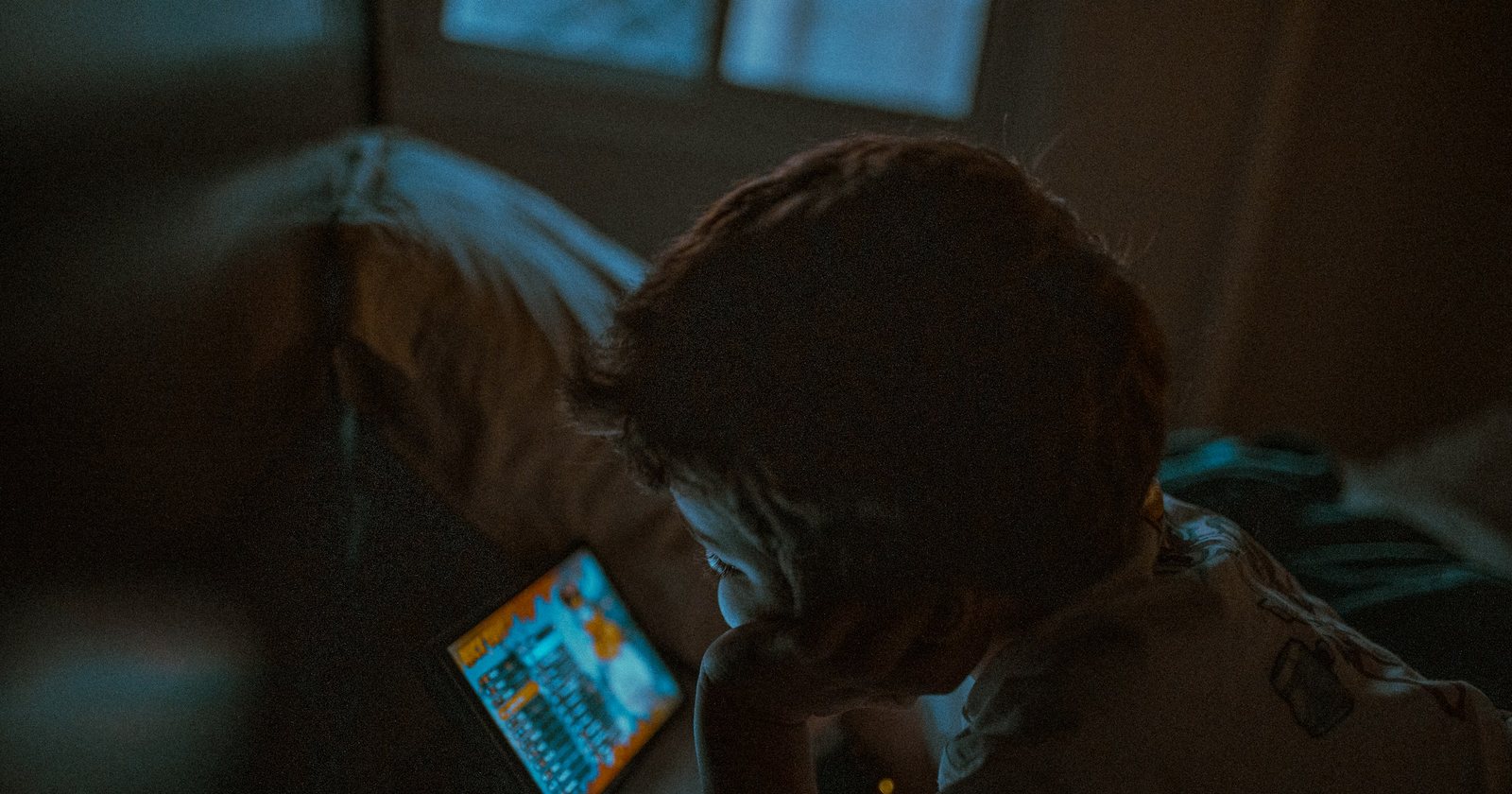
The short answer: yes and no. Blue light has a real effect — bright light in the evening slows melatonin release and delays sleep onset — but its role is widely overstated. The problem with your screens at night is as much what you're watching as the color of the screen. A feed you keep scrolling, a show that keeps you hooked, a notification begging for a reply: that mental stimulation keeps your brain awake at least as much as a bit of bluish glow.
In other words: blue-light glasses won't save you if you scroll until 1 a.m. Tackle both problems — the light and the stimulation — and that changes everything.
What does light at night do to your sleep?
Your internal clock sets itself by light. In the evening, darkness triggers melatonin, the hormone that signals nighttime and gets you ready to fall asleep. Bright light — the ceiling light on full, a bright screen at arm's length — sends the opposite signal: “it's still daytime.” As a result, melatonin rises later and it takes you longer to fall asleep. Two clarifications put things in perspective:
- What matters most is intensity, not just the blue tint. A brightly lit room in the evening weighs more than a phone in dark mode. In 116 volunteers, ordinary room lighting (under 200 lux) before bed shortened the melatonin secretion period by about 90 minutes compared with dim light.
- Distance matters enormously: a ceiling light above your head exposes you far more than a smartphone held 30 centimeters (about a foot) away.
Is it the light or the content that keeps you awake?
This is the part blue-light filters don't fix. “Activating” content — social media, news, games, work email, tense conversations — triggers dopamine and alertness at the exact moment you should be winding down. Your body may be lying down, but your nervous system is in a meeting. That's why you can spend an hour on your phone “to relax” and end up more awake than when you started. A paper book, a calm podcast or a low-key show don't pose the same problem, even at the same brightness: the screen isn't the devil, but what's on it can be. A panel of 16 experts convened by the National Sleep Foundation (2024) concluded that content watched before bed harms sleep in children and teens, but reached no consensus on screen light, or on adults, for lack of strong enough studies.
The test is telling: compare an evening spent reading under a low lamp with an evening of back-to-back messaging, with the screen set the same way. The first puts you to sleep; the second leaves your brain buzzing. The difference doesn't come from the light, it comes from the stimulation — and no filter neutralizes it.
How to use screens at night without ruining your sleep
No need to ban screens — just tone them down in the evening:
- Lower the brightness and turn on night mode or warm light after sunset. Free, but no miracle: in a 2021 trial of 167 young adults, the iPhone's Night Shift mode made no difference to sleep.
- Dim the room. Switch off the ceiling light and move to a low, warm lamp. It's the most underrated lever — ambient lighting matters more than the screen itself. An international expert consensus (2022) recommends very dim light during the 3 hours before bed, then the most complete darkness possible for sleep.
- Turn off screens 30 to 60 minutes before bed, especially activating content. Can't manage that? Aim for at least the last 15 minutes without scrolling.
- Get your phone out of the bedroom or put it in airplane mode: half the problem is the temptation to “just check.”
- Keep the bedroom for sleep. Your brain associates places with activities: if you work and scroll in bed, it learns that bed is a place where you stay awake.
These habits form the core of a good evening routine. Combined with regular sleep times, they do more for your nights than any gadget — especially for your deep sleep, which is very sensitive to what happens in the hour before bed.
Do blue-light glasses work for sleep?
Be cautious. The evidence is thin and contradictory: a 2023 Cochrane review (17 trials) rates their effect on sleep as uncertain — of the six trials that measured it, three saw an improvement and three found no difference. They don't replace lowering the brightness or cutting off activating content. If they help you build a “put them on, slow down” ritual, great — but then it's the ritual doing the work, not the tinted lenses. Put your energy into light intensity and what you're doing, not the accessory.
Key takeaways
- Bright evening light does delay sleep, but intensity and distance are what count, not just the blue tint.
- The mental stimulation of activating content weighs as much as the light: blue-light filters don't fix it.
- Lower the brightness, dim the room, cut activating content 30 to 60 minutes before bed: that's what works, not the glasses.
Frequently asked questions
Does blue light really keep you from sleeping?
It contributes: bright evening light slows melatonin and delays sleep onset. But what matters most is intensity and the mental stimulation of the content, not just the blue tint.
Do blue-light glasses work?
The evidence is thin and contradictory: a 2023 Cochrane review rates their effect on sleep as uncertain. Lowering the brightness, dimming the room and cutting activating content in the evening work much better.
How long before bed should you stop using screens?
Aim for 30 to 60 minutes screen-free before bed, starting with activating content like social media, news or work. Even just a final 15 minutes without scrolling already helps.
Sources
- Gooley JJ, Chamberlain K, Smith KA, et al. Exposure to room light before bedtime suppresses melatonin onset and shortens melatonin duration in humans. J Clin Endocrinol Metab. 2011. doi:10.1210/jc.2010-2098
- Brown TM, Brainard GC, Cajochen C, et al. Recommendations for daytime, evening, and nighttime indoor light exposure to best support physiology, sleep, and wakefulness in healthy adults. PLoS Biol. 2022. doi:10.1371/journal.pbio.3001571
- Hartstein LE, Mathew GM, Reichenberger DA, et al. The impact of screen use on sleep health across the lifespan: A National Sleep Foundation consensus statement. Sleep Health. 2024. doi:10.1016/j.sleh.2024.05.001
- Singh S, Keller PR, Busija L, et al. Blue-light filtering spectacle lenses for visual performance, sleep, and macular health in adults. Cochrane Database Syst Rev. 2023. doi:10.1002/14651858.CD013244.pub2
- Duraccio KM, Zaugg KK, Blackburn RC, Jensen CD. Does iPhone night shift mitigate negative effects of smartphone use on sleep outcomes in emerging adults? Sleep Health. 2021. doi:10.1016/j.sleh.2021.03.005
What this article explains,
the app measures for you.
Ecleptic brings your sleep, nutrition and training together in one score, every morning. The iOS beta is open to a small circle.
Request access